

As a professional artist, your primary focus is likely to be on creating artwork, rather than dealing with technical aspects such as SEO (search engine optimization) or managing social media accounts.
However, in today’s digital age, online visibility is important for reaching a broader audience and increasing the chances of selling your work.
In the following paragraphs, we’ll break down the role of each channel, helping you to understand their unique benefits and how they can complement each other.
This simple guide will provide you with the insights needed to make the most of your time and enhance your SEO efforts effectively.
Social media: useful, but not directly for SEO
When you post on platforms like Facebook, Instagram, or Twitter, you create visibility, but these posts don’t directly impact your website’s SEO.
The links you share are often « nofollow, » meaning Google doesn’t use them to improve your ranking in search results.
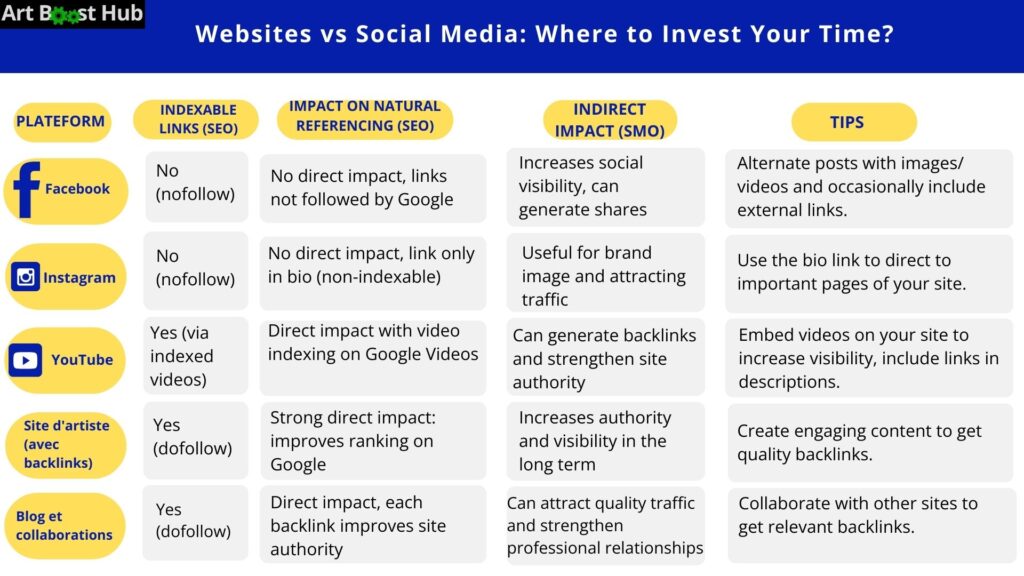
- Facebook : The links in your posts are nofollow, meaning they don’t contribute to your SEO, although they can generate temporary traffic.
- Instagram : No clickable links in posts, except in the bio. However, this link is not indexed by Google.
- LinkedIn and Twitter : Similar to Facebook, the links are nofollow, although some images may appear in Google Images.
- Pinterest : Notable exception, pins on Pinterest are dofollow and directly influence your SEO if they point to your site.
- YouTube : YouTube is a unique case. If you publish a video directly on YouTube, Google will index this video in Google Videos and in the universal search. You can include a link to your website in the video description or embed the video on a page of your site to give it more visibility and potentially encourage other sites to create links to it.
Is it necessary to share your website on social media?
Yes! Even if most social media don’t directly contribute to a website’s SEO, their value lies elsewhere! Don’t overlook social media optimization (SMO).
SMO: the link between social media and SEO
SMO refers to techniques that enhance your brand image and visibility on social media. Although links on social media are not directly considered by Google for ranking, a well-organized social strategy can attract visitors to your site, but :
While sharing links might initially seem like a smart way to generate traffic, the caveat is that doing so too often can decrease the organic reach of your posts. This happens because the algorithms prioritize content like images, videos, or text over posts with external links, leading to less visibility for your content in users’ feeds.
The Iindirect impact of social media on SEO
Even though social media doesn’t directly influence your Google ranking, it plays a significant role in enhancing your online visibility.
According to a Redacteur.com article published on January 23, 2024, when users search for your name or brand on Google, your social media profiles often appear alongside your website. This underscores the importance of being active and well-referenced on social media, as it can amplify your overall presence online.
SMO is primarily about building a community around your brand. The more followers engage with your posts, the greater your brand’s visibility and influence.
In other words, while social media may not directly boost SEO, it can still generate traffic and attention.
Social media is vital for online visibility, but it should be used strategically to complement your SEO efforts rather than as a direct SEO tool.
Websites: the main asset for SEO
A well-optimized website is the primary tool for improving your positioning on Google. Unlike social media, backlinks from other websites are considered by Google to evaluate the relevance and popularity of your content :
- Backlinks : If other websites mention you and add links to your site, it acts as a « recommendation » for Google. The more these links come from reliable sources, the better your SEO. For example, Art Boost Hub creates backlinks by including a link to your site on its page https://artboosthub.site/the-artists/.
- Content: Regularly updating your pages—for example, by announcing your latest exhibition or writing a post afterwards to thank your visitors—along with publishing blog articles and tagging images appropriately, is essential for ensuring your site is well-referenced. Once you’ve updated your site, you can request a boost from ABH here: https://artboosthub.site/boost/
- Internal Linking : Creating links between your different pages strengthens the structure of your site and helps Google better understand and reference your content.
Key factors affecting your website's Google ranking
A website’s ranking in Google’s search engine is influenced by three criteria:
-
Technical Criteria: Is the website mobile-friendly, fast, user-friendly, and does it have clean HTML code?
-
Content Criteria: Does the website answer the user’s query with its content (pages, texts, titles, images) and internal linking?
-
Popularity Criteria: Does the website benefit from quality links pointing to it and how many? Do sites in the same niche link to it?

The role of Art Boost Hub in enhancing your SEO
This is where Art Boost Hub comes into play. Artists featured on the page https://artboosthub.site/the-artists/ will benefit from an external link to their website. Google sees these links as « recommendations, » which positively impact your site’s ranking.
The more high-quality links directed to your site, the more Google perceives it as popular and authoritative.
The key is to focus on earning links from reputable sources within the art field. With Art Boost Hub, we can take it a step further: by mentioning Art Boost Hub on your site, you contribute to its growing popularity and authority, which benefits all artist members. Likewise, when one artist mentions another member, it strengthens the collective. This is the essence of Art Boost Hub!
Specific tips to improve your ranking on google, bing, yahoo
Conclusion: Every Art Boost Hub member plays a role
-
Optimize Your Website: Ensure your site is mobile-friendly, fast, and user-friendly. Use clean HTML tags and optimize your images with appropriate alt tags.
-
Create Quality Content : Regularly publish blog articles, updates on your works, and detailed descriptions of your projects. The more relevant and useful your content, the better it will be referenced.
-
Use Internal Linking : Create links between your different pages to strengthen the structure of your site and help Google better understand and reference your content.
-
Participate in Social Media : Even if links on social media are nofollow, they can generate traffic and attention. Regularly publish high-quality content to anticipate potential future consideration by Google.
-
Collaborate with Other Artists: Use ArtBoostHub to create collaborations and obtain quality backlinks. The more links pointing to your website, the more Google understands that your site is popular and has some authority.
Balancing your efforts between a well-optimized website and a social media presence can help you maximize visibility and authority, even if the direct impact on SEO differs between the two platforms.
Your time is precious and of course you should focus more on your creative work than on digital communication.
That’s why I want to ensure that our platform is as efficient and effective as possible to help you grow your online presence without wasting your time. This quick form is designed to get your feedback and ideas—filling it out should take only a few minutes.
Please fill out this quick form in French, English, or Swedish—it won’t take much time, and your input will directly contribute to helping us help you increase your online visibility.
So I should make a YouTube account for my art, is that what you are saying?
Hello Adelheid,
I’m not pretending to know what anyone should do. My goal is to provide tools to help increase your visibility on the internet without requiring too much time or money. In this article, I’m sorting out where to spend your time more effectively, but it really depends on what you want to achieve.
Creating videos for your YouTube channel can be time-consuming, but it can also be a great source of inspiration. A single video can be used across your social media platforms and website.
Creating a YouTube channel can be a significant asset for professional artists, not only increasing visibility but also generating direct sales through the power of video content.
On the other hand, managing a YouTube channel professionally takes time—a precious resource for an artist already dedicating much of their effort to creating their work. Filming, editing, and publishing videos regularly can become a time-consuming task. It’s often necessary to invest in equipment: a good camera, microphones, and editing software are essential for producing professional-quality videos.
Moreover, YouTube is a highly competitive platform. It’s not enough to simply upload a video and expect to gain views. You also need a well-defined strategy, including SEO optimization (titles, descriptions, keywords), to ensure your videos are found by viewers.
Best regards
Ulrica
Well, so I did! 😀 https://www.youtube.com/@adelheidottesenart/community